
Every multiplayer online battle arena (MOBA) player faces the same challenge: finding a game that rewards deep strategic thinking, precise execution, and constant adaptation. Dota 2 delivers exactly that — a competitive experience built on layers of tactical decisions, a fully accessible roster, and a thriving esports ecosystem. With all 124 dota 2 heroes available from the first match, a multi-tier ranking system that tracks progress through MMR, and The International tournament offering prize pools exceeding $40 million, the game sets the standard for competitive MOBAs. The 2026 competitive season continues to attract millions of players globally, with regional qualifications through MENA and WEU circuits feeding into major tournaments. High competitive activity also drives the growth of the Dota 2 betting market, where platforms like luks casino offer fans a wide range of betting lines, high odds, and the opportunity to make real-time match predictions.
Dota 2 as a Benchmark for Complexity and Strategic Depth in the MOBA Genre
Dota 2 stands apart from other MOBAs through its commitment to mechanical complexity and decision layering. The game features 124 unique heroes, each with four to five active abilities, plus an item system containing over 200 purchasable objects that fundamentally alter gameplay. Unlike competitors that streamline mechanics for accessibility, Dota 2 embraces nuance: attack animations vary by hero, turn rates affect movement responsiveness, and vision operates through granular elevation rules.
The map itself functions as a tactical puzzle. High ground grants vision advantage and miss chance to attackers. Juke paths through trees create escape routes. Roshan, the primary neutral objective, spawns at variable intervals and drops the Aegis of Immortality — a single-use resurrection item that often determines late-game fights. Teams must coordinate smoke ganks, ward placements, and creep wave manipulation to gain incremental advantages.
Strategic depth extends to the drafting phase. The Captain’s Mode format features five bans and five picks per team, creating a meta-game where composition counters and synergy define matches before the first creep spawns. Professional teams employ dedicated analysts to study opponent tendencies and prepare specific draft strategies. A single unexpected hero pick can invalidate an opponent’s entire game plan, making adaptability crucial at every skill level.
Monetization and Esports Balance: 100% Availability of All Dota 2 Heroes
Every dota 2 hero is immediately playable without purchase or grinding, a monetization philosophy that prioritizes competitive integrity over revenue extraction. This full roster access eliminates pay-to-win concerns and ensures matchmaking fairness — a level 1 account has identical strategic options to a veteran’s. Valve generates revenue exclusively through cosmetic items: character skins, ability visual effects, announcer packs, and seasonal Battle Pass content.
The Battle Pass system offers tiered rewards through level progression. Players complete weekly quests, wager on match outcomes, and participate in limited-time events to unlock exclusive cosmetics. The International Battle Pass historically contributes 25% of sales to the tournament prize pool, directly linking community spending to competitive rewards. In 2026, cosmetic sales remain the sole monetization vector, with no gameplay-affecting microtransactions.
This economic model influences esports sustainability. Because all players access identical tools, tournament results reflect pure skill rather than roster advantages. Betting platforms like GG.BET and LVBet leverage this competitive purity, offering odds on matches where hero availability never skews outcomes. The transparent balance between free competitive access and optional cosmetic spending has become a case study for sustainable esports monetization.
Matchmaking and the Multi-Level Ranking System (MMR)
The dota 2 rank system operates through Matchmaking Rating (MMR), a numerical value reflecting player skill. Ranked matchmaking spans eight tiers: Herald, Guardian, Crusader, Archon, Legend, Ancient, Divine, and Immortal. Each tier (except Immortal) subdivides into five stars, creating 36 distinct ranks. Players gain or lose approximately 20-30 MMR per match based on performance and outcome.
Seasonal recalibration occurs every six months. Players complete ten placement matches that reassess their skill bracket, preventing stagnation and accounting for meta shifts. The system employs behavior score tracking alongside MMR — players who abandon matches, receive reports, or exhibit toxic communication face lower-priority queues and longer matchmaking times. This dual-metric approach aims to balance competitive accuracy with community health.
Immortal rank functions differently. The top tier displays exact MMR publicly and ranks players on regional leaderboards. Achieving Immortal status typically requires 5,500+ MMR and places players in the top 1% of the global population. Professional scouts monitor leaderboards to identify emerging talent, making high-rank matchmaking a direct pipeline to competitive teams. Role queue further refines matchmaking by letting players select preferred positions (carry, support, offlane, midlane, roamer) before queuing, reducing in-game role conflicts.
Open Tournament Season Format and the Specifics of Qualifications via MENA or WEU
The Dota Pro Circuit (DPC) structures the competitive calendar through regional leagues and major tournaments. Six regions compete: China, Southeast Asia, Eastern Europe, Western Europe (WEU), North America, and South America. In 2023, Valve introduced MENA (Middle East and North Africa) as a distinct qualifying region, recognizing growing player bases in Turkey, Saudi Arabia, and surrounding countries.
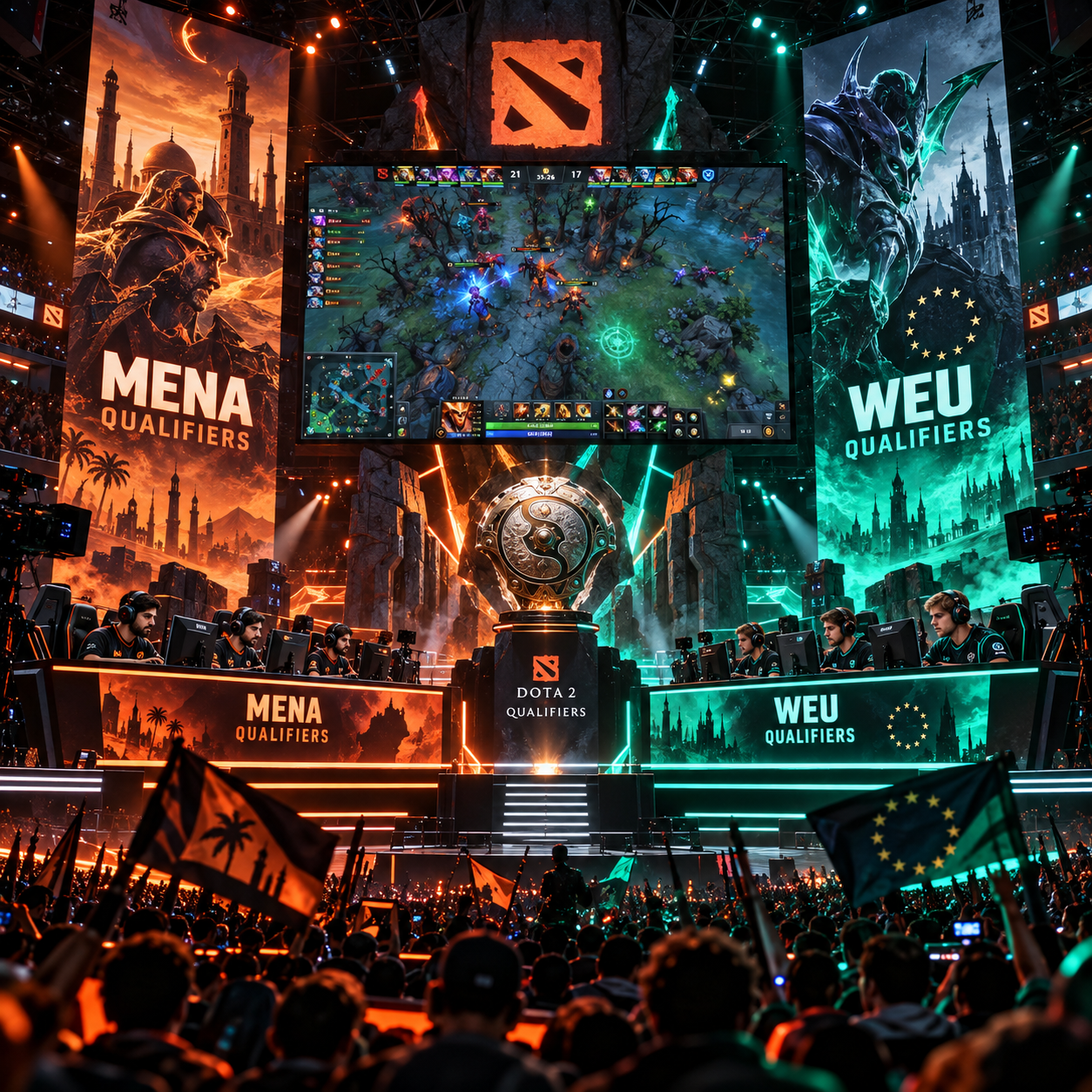
WEU qualifications feature established organizations like Team Liquid, OG, and Tundra Esports competing in division-based leagues. Division I contains eight teams playing round-robin matches for DPC points and major invitations. MENA qualifications operate through open qualifiers leading to closed regional finals, offering a pathway for emerging rosters to challenge established squads. Turkish teams frequently compete through MENA slots, benefiting from geographic proximity and reduced ping to European servers.
Each DPC season culminates in three majors: Spring, Summer, and Fall. Majors award DPC points that determine direct invitations to The International. Teams accumulating insufficient points must navigate regional qualifiers, creating high-stakes matches where a single elimination ends championship dreams. This format rewards consistent year-round performance while preserving Cinderella story potential through open brackets.
Economic and Cultural Phenomenon of the Dota 2 International Tournament
The dota 2 international 2026 took place in Shanghai, China, from August 20 to 23, with 16 teams competing for the Aegis of Champions. The tournament’s crowd-funded prize pool reached $42.7 million, making it the largest single-event payout in esports history. Team Spirit and Team Vision entered as betting favorites on platforms offering dota 2 international 2026 winner odds, reflecting their dominant regional performances.
The International’s economic impact extends beyond prize distribution. Host cities experience tourism surges as fans travel internationally to attend. Shanghai’s 2026 event drew 18,000 daily attendees to the Mercedes-Benz Arena, with local businesses reporting revenue spikes from fan spending. Broadcast viewership peaks at 3+ million concurrent viewers across Twitch, YouTube, and regional platforms, attracting sponsorships from peripheral industries like energy drinks, computer hardware, and automotive brands.
Culturally, The International elevates esports legitimacy. Mainstream media coverage treats the event as a major sporting occasion, analyzing team strategies and player storylines with the same depth as traditional athletics. The tournament’s format — group stage, upper and lower bracket playoffs, grand finals — mirrors established sporting conventions, making it accessible to non-endemic audiences. For players in regions with limited esports infrastructure, The International represents a singular opportunity: winning the Aegis guarantees financial security and permanent legacy within the game’s history.
Update Analytics: Massive Patches That Globally Change the Rules of the Game
Valve releases two types of patches: incremental balance adjustments (bi-weekly) and massive gameplay overhauls (biannual). The latter category reshapes fundamental mechanics. Patch 7.33 (April 2023) introduced map asymmetry, giving Radiant and Dire sides unique neutral camp layouts. Patch 7.34 (August 2023) reworked ten hero abilities and added new Aghanim’s Scepter effects, invalidating months of strategic preparation.
Massive patches force meta reinvention. A hero with 55% win rate pre-patch may drop to 45% post-adjustment, rendering practiced strategies obsolete. Professional teams employ analysts who parse patch notes within hours, identifying buffed heroes and emerging synergies. The period immediately following major patches sees chaotic drafting as teams experiment, creating unpredictable tournament outcomes and exciting betting markets.
Community response to patches divides between casual and competitive players. Casual players appreciate freshness and variety. Competitive players face pressure to relearn interactions under time constraints — a major patch three weeks before The International creates preparation nightmares. Valve typically avoids patching within four weeks of major tournaments, but mid-season patches remain controversial. This tension between game health and competitive stability defines Dota 2’s live-service model.
Tactical Advantage: Map Dynamics, Vision System, and the Impact of Active Items
Map dynamics in Dota 2 revolve around three lanes, two jungles, and Roshan’s pit. Each lane contains three towers per side, barracks that upgrade creep waves when destroyed, and an Ancient building serving as the win condition. The river divides the map diagonally, with runes spawning every two minutes at marked locations — power runes grant temporary buffs (haste, double damage, invisibility), while bounty runes provide gold.
Vision operates through unit sight range and elevation rules. Observers see 1,800 units in daylight, reduced to 800 at night (game time cycles every five minutes). Placing observer wards on high ground extends vision radius and reveals lower terrain. Sentry wards detect invisible units but grant no vision themselves. Effective warding requires predicting enemy movement patterns and protecting key areas: Roshan’s pit, rune spots, and jungle entry points.
Active items multiply tactical possibilities. Black King Bar grants magic immunity for 5-9 seconds, countering disable-heavy lineups. Blink Dagger enables instant 1,200-range repositioning, turning immobile heroes into initiation threats. Scythe of Vyse transforms enemies into harmless critters for 3.5 seconds, disabling all abilities. Item timings dictate power spikes — a carry completing Battle Fury at 12 minutes farms exponentially faster, while a support rushing Glimmer Cape saves allies from targeted ultimates. Mastering active item usage separates skilled players from average ones; professional matches feature per-minute item activation rates exceeding 30 clicks.
The Future of Dota 2 in the Global Esports Ecosystem
Dota 2 faces competition from Riot Games’ aggressive League of Legends circuit and mobile MOBAs capturing Asian markets. Valve’s hands-off management style contrasts with Riot’s centralized league structure, creating sustainability questions. However, Dota 2’s decentralized tournament ecosystem — third-party organizers run majors, DreamLeague, ESL events — distributes risk and prevents single-point failure. Regional leagues in MENA and South America continue expanding, tapping previously underserved player bases.
Technological integration shapes the game’s trajectory. Valve experiments with VR spectating and in-game betting integration (viewers wager cosmetic items on match outcomes through official channels). Machine learning tools analyze replays, offering players personalized improvement suggestions. These features position Dota 2 as a platform beyond the core 5v5 experience, monetizing engagement through prediction markets and coaching services.
Long-term viability depends on attracting new players despite the steep learning curve. Tutorial improvements in 2025 introduced guided bot matches and coached hero introductions, reducing early-game frustration. Veteran player retention remains strong — the median player has 2,000+ hours logged, indicating deep engagement. As long as The International maintains cultural relevance and prize pool growth, Dota 2 will sustain its position as the premium skill-testing MOBA, even if total player counts trail more accessible competitors.
FAQ
How many heroes are available in Dota 2 without payment?
All 124 dota 2 heroes are accessible from the first match without any purchase required. The game monetizes exclusively through cosmetic items, ensuring competitive balance regardless of spending. This full roster availability distinguishes Dota 2 from MOBAs that lock characters behind paywalls or grinding.
What MMR value corresponds to each rank tier?
Herald spans 0-770 MMR, Guardian 770-1,540, Crusader 1,540-2,310, Archon 2,310-3,080, Legend 3,080-3,850, Ancient 3,850-4,620, Divine 4,620-5,420, and Immortal begins at 5,420+ MMR. Each tier subdivides into five stars except Immortal, which displays exact numerical rating. Seasonal recalibration adjusts these thresholds based on player distribution.
When and where will The International 2027 take place?
Valve has not announced The International 2027 location or dates as of early 2026. Historical patterns suggest an August timeframe with venue announcements occurring 4-6 months prior. Following Shanghai’s 2026 hosting, rotation may return to European or North American cities based on Valve’s regional balance strategy.
How do MENA region teams qualify for major tournaments?
MENA teams compete through regional open qualifiers feeding into closed qualifiers. Top performers earn DPC points and slots at seasonal majors. Direct International invitations require top-three regional league finishes or sufficient DPC points accumulated across the season. Turkish teams frequently compete through MENA brackets due to geographic and server proximity.
Do massive patches release on a fixed schedule?
No fixed schedule governs massive Dota 2 patches. Valve typically releases major gameplay overhauls twice yearly, often post-International and mid-season. Patch timing avoids proximity to major tournaments — Valve implements a four-week quiet period before The International to preserve competitive stability. Incremental balance patches occur bi-weekly regardless of tournament schedules.
Which active items provide the greatest tactical impact?
Black King Bar, Blink Dagger, and Scythe of Vyse consistently rank as highest-impact active items. BKB’s magic immunity counters disable-heavy drafts, Blink enables initiation on immobile heroes, and Scythe offers reliable hard disable. Situational items like Glimmer Cape (invisibility save), Force Staff (repositioning), and Eul’s Scepter (cyclone disable) solve specific tactical problems based on draft composition.
Can betting platforms offer odds on all dota 2 matches?
Licensed platforms like GG.BET and LVBet provide odds on tier-1 professional matches, DPC leagues, and major tournaments. Lower-tier regional games receive limited coverage due to liquidity constraints. The International generates the highest betting volume annually, with winner, series score, and live in-game markets available. Regulatory compliance varies by jurisdiction — Turkish players should verify local licensing before engaging betting services.